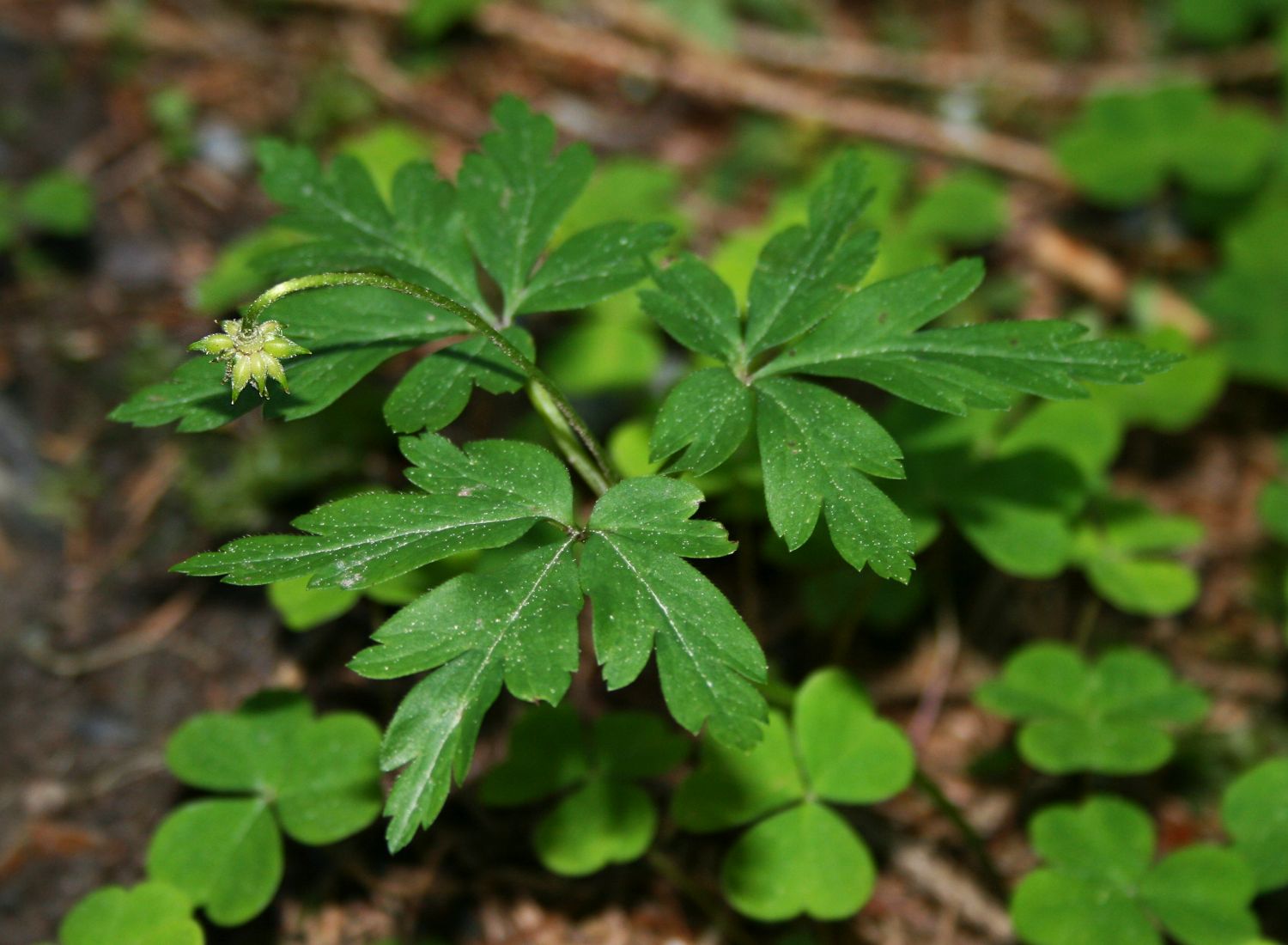
Mature Quercus robur stands in Poland produce a canopy that intercepts a substantial proportion of incoming light by mid-summer. Measurements in lowland oak-hornbeam forest (Galio sylvatici-Carpinetum) and pure oak stands record relative irradiance at ground level ranging from roughly 1–5% of full daylight under closed canopy, rising to 15–25% in gaps or along woodland edges. The herbaceous layer beneath such canopies is shaped almost entirely by this constraint.
Establishing or restoring ground cover in these conditions requires choosing species whose physiology is adapted to very low photon flux densities. A number of native Polish woodland herbs fit this requirement and have a documented distribution in oak-dominated communities across the country.
Why Oak Canopy Presents Specific Challenges
Beyond low light, mature oak woodland presents two additional constraints for ground cover establishment. First, oak roots are wide-ranging and compete actively for soil moisture and nutrients, particularly in the upper soil horizons where fine roots of herbaceous plants concentrate. Second, the annual leaf fall from oak produces a thick, slow-decomposing litter layer — particularly where hornbeam is absent — which can smother small seedlings and alter soil surface conditions.
Species adapted to these conditions have generally evolved mechanisms to cope with one or more of these constraints: early seasonal growth before canopy closure, a geophytic life form (bulbs, rhizomes, tubers) that allows dormancy during the most competitive period, or low nutrient requirements consistent with oak forest soils.
Spring Ephemerals and Early-Season Species
Anemone nemorosa (wood anemone) is one of the most characteristic ground-layer species of central European oak woodland. It exploits the spring light window — the period between snowmelt and full leaf-out — to complete much of its annual growth and reproduction. By June it is largely dormant underground, avoiding the deep shade of summer entirely. This strategy allows it to function as ground cover in the visual and ecological sense through the most aesthetically critical period of the year.

Oxalis acetosella (wood sorrel) is less strictly ephemeral — its leaves persist through summer under moderate canopy conditions — and it is consistently recorded in the ground layer of oak woodland on acidic soils across Poland. Unlike Anemone nemorosa, it tolerates deeply shaded summer conditions and spreads by rhizome across suitable substrate.
Persistent Shade-Tolerant Ground Cover
For year-round visual cover, the following species are more appropriate than spring ephemerals. They maintain above-ground leaf tissue through the growing season and recover reliably in subsequent years.
| Species | Growth Form | Shade Tolerance | Soil Preference |
|---|---|---|---|
| Galium odoratum | Rhizomatous herb | High | Moist, base-rich |
| Carex sylvatica | Tufted sedge | High | Moderately moist |
| Lamium galeobdolon | Stoloniferous herb | Moderate–high | Variable |
| Asarum europaeum | Low rhizomatous | Very high | Moist, calcareous |
| Viola reichenbachiana | Rosette herb | High | Variable, mesic |
Galium odoratum
Galium odoratum (sweet woodruff) forms dense mats under established deciduous canopy and is among the most reliable ground cover options for moist, moderately base-rich soils. In Polish beech and oak-hornbeam forests it commonly covers large areas at nearly continuous density. Spread occurs by rhizome; seed establishment is slow. Its response to summer drought is unfavourable — sites with consistent soil moisture from spring through August support the densest growth.

Asarum europaeum
Asarum europaeum (European wild ginger) grows at very low light intensities and is frequently found in the deepest-shaded portions of oak and oak-hornbeam stands. Its kidney-shaped evergreen leaves form a low, tight mat that suppresses many weedy species. Growth is slow — rhizome extension of a few centimetres per year is typical — so it is unsuitable where rapid cover is required. However, once established, it is persistent and requires almost no management.
Practical Note: Litter and Establishment
- Thick oak litter reduces emergence from seed but is generally tolerated by rhizomatous transplants once roots reach mineral soil.
- Planting into existing litter is feasible with transplants; light raking to expose mineral soil at planting spots improves first-year establishment.
- Species with stolons (Lamium galeobdolon) or rhizomes (Galium odoratum, Asarum europaeum) spread laterally without depending on seed, which is advantageous in shaded conditions where seed germination rates are low.
Carex sylvatica and Viola reichenbachiana
Carex sylvatica (wood sedge) is a tufted sedge found in moderately to heavily shaded oak and oak-hornbeam forest across central Poland. It does not form continuous mats but provides structural interest and stabilises soil on slopes or where the litter layer is thin. Viola reichenbachiana (pale wood violet) is a rosette-forming violet with a wide ecological amplitude in woodland — it tolerates both deep shade and drier conditions than Galium odoratum requires, and self-seeds reliably once established.
Compatibility with Existing Oak Woodland Structure
All species listed here are recorded components of natural oak woodland communities in Poland and present no risk of disrupting the existing forest structure. They are compatible with the root systems of mature Quercus robur and with associated shrub layers (e.g., Corylus avellana, Euonymus europaeus) typically present in semi-natural woodland.
Introducing these species into degraded woodland — where ground cover has been lost to disturbance, deer browsing, or invasion by non-native plants — is consistent with the recommendations of the Institute of Nature Conservation of the Polish Academy of Sciences for passive and active woodland restoration in temperate Europe.
References
- Matuszkiewicz, J.M. (2001). Zespoły leśne Polski. Wydawnictwo Naukowe PWN, Warsaw.
- Tokarska-Guzik, B. et al. (2012). Rośliny obcego pochodzenia w Polsce. Generalna Dyrekcja Ochrony Środowiska, Warsaw.
- Ellenberg, H. (1988). Vegetation Ecology of Central Europe. Cambridge University Press.
- Institute of Nature Conservation, Polish Academy of Sciences
