
The following profiles cover eight herbaceous species documented in the native flora of Polish oak woodland. Each profile includes ecological requirements, distribution in Poland, ground cover characteristics, and practical notes on establishment. Species are arranged from the most shade-tolerant to those requiring moderate light conditions.
All species are listed in the Flora Polski and are native or archaeophytic in the relevant woodland habitats. None are invasive or require special handling permissions for planting in private or managed woodland in Poland.
1. Asarum europaeum — European Wild Ginger

Asarum europaeum (haselwurz, European wild ginger) is a low-growing, rhizomatous perennial whose kidney-shaped, glossy leaves form a near-continuous mat in the right conditions. It is among the most shade-tolerant herbaceous species in central European forests, recorded in sites where photosynthetically active radiation at the forest floor falls below 1% of full sunlight.
In Poland, it occurs primarily in oak-hornbeam forest (Tilio-Carpinetum), beech forest, and occasionally in dense oak stands on calcareous or base-rich, moist soils. It is absent or rare on dry acidic sands.
- Height: 5–10 cm
- Spread: Rhizomatous; expansion rate of a few centimetres per year
- Soil: Moist to moderately moist, pH 5.5–7.5, nutrient-moderate
- Shade: Very deep shade tolerated; optimal in 1–5% relative irradiance
- Establishment: Slow from transplants; autumn or early spring planting preferred
2. Oxalis acetosella — Wood Sorrel
Oxalis acetosella is one of the most widespread woodland herbs in Poland and across temperate Europe. Its trifoliate leaves close at night and in bright light — a distinctive response known as nyctinasty — and its clover-like appearance makes it immediately recognisable. It tolerates very deep shade but is less competitive on dry or compacted soils.
In oak woodland it is most frequent on acidic, humus-rich soils and in areas with consistent soil moisture. On calcareous sites it may be absent or replaced by other oxalidaceae.
- Height: 5–15 cm
- Spread: Rhizomatous; forms loose patches
- Soil: Acidic to slightly acidic, moist, humus-rich
- Shade: Very deep shade tolerated
- Establishment: Divide rhizomes in spring or autumn; seed germination slow and unreliable in shade
3. Anemone nemorosa — Wood Anemone
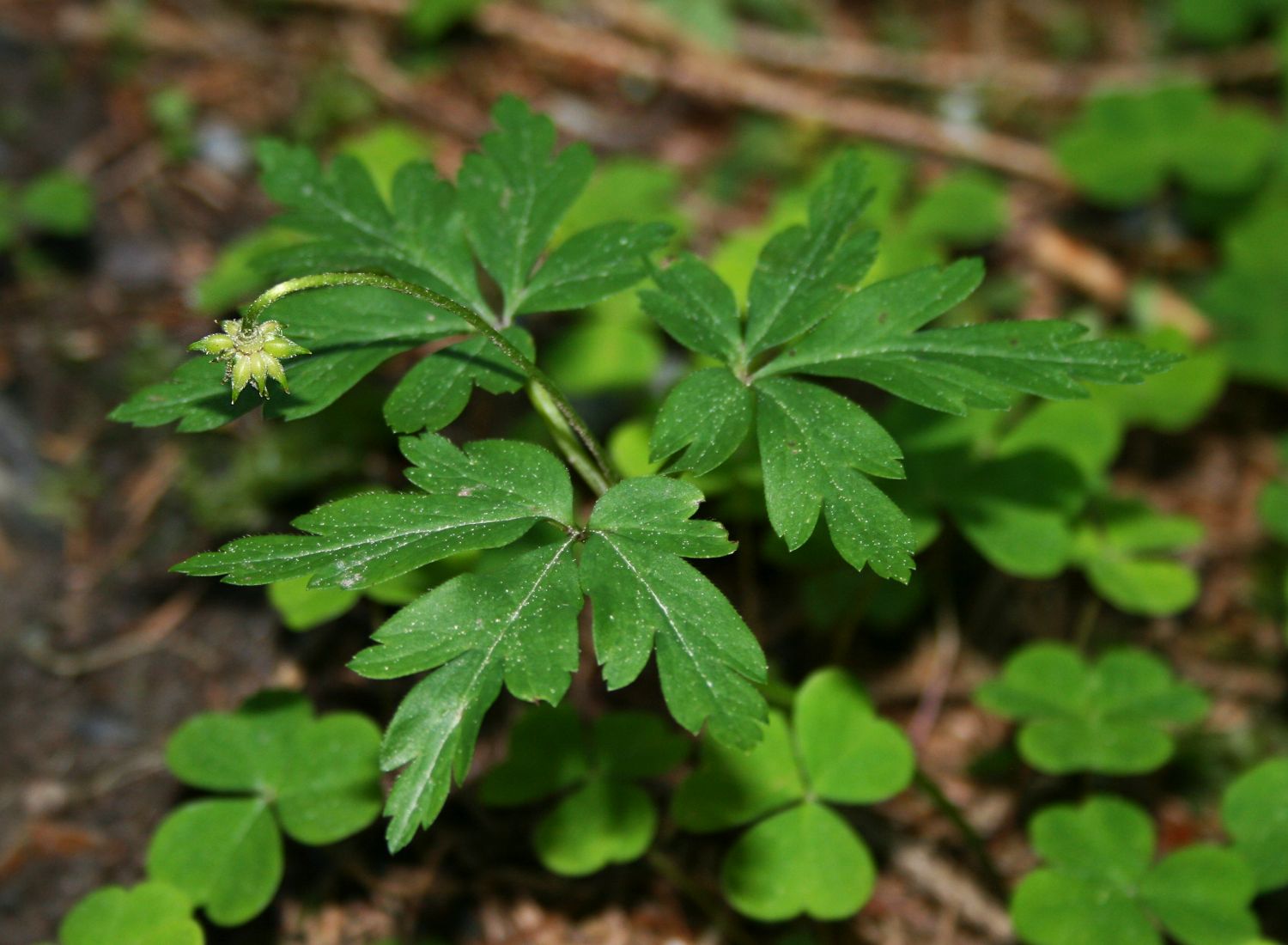
Anemone nemorosa (wood anemone, zawilec gajowy) is a spring ephemeral that exploits the pre-leaf-out window to flower and set seed, then retreats underground until the following spring. Its white flowers are among the earliest and most visible indicators of ancient or undisturbed woodland in Poland.
It is a recognised ancient woodland indicator species in many parts of central Europe. Its presence in a woodland is often used as evidence of long continuity, since it spreads slowly and does not colonise newly planted woodland for decades.
- Height: 10–25 cm (in flower)
- Above ground period: March to June
- Spread: Horizontal rhizome extension; forms large colonies over time
- Soil: Variable; moderately moist, well-drained, pH 4.5–7.0
- Establishment: Plant divided rhizomes 3–5 cm deep in autumn (September–October)
4. Galium odoratum — Sweet Woodruff
Galium odoratum (sweet woodruff, marzanka wonna) is a rhizomatous perennial that forms dense, continuous ground cover in the right conditions. It has whorled, lance-shaped leaves and small white flowers in spring. Its leaves contain coumarin compounds that produce a characteristic scent when dried.
In Polish oak-hornbeam and beech-oak forest it is a frequent dominant of the ground layer on moist, moderately base-rich soils. It is absent on dry, acidic sandy soils. It is one of the most reliably establishing and persistent ground cover species in shaded woodland conditions.
- Height: 15–30 cm
- Spread: Vigorous rhizomatous spread; can cover large areas within 3–5 years from modest initial density
- Soil: Moist, moderately base-rich, pH 5.5–7.5
- Shade: High — performs best at 2–10% relative irradiance
- Establishment: Root divisions in spring or autumn; also by transplant
5. Viola reichenbachiana — Pale Wood Violet

Viola reichenbachiana (pale wood violet, fiołek leśny) is a rosette-forming violet with small pale purple flowers in April–May. It is one of the most common violet species in Polish woodland across a range of soil conditions. It self-seeds reliably once established, and established plants tolerate both drought and deep shade better than many other woodland herbs.
- Height: 5–20 cm
- Spread: Self-seeding; also short rhizome
- Soil: Variable; tolerates both moist and moderately dry conditions
- Shade: High — tolerates very deep shade
- Establishment: Transplants or direct seeding in autumn
6. Carex sylvatica — Wood Sedge

Carex sylvatica (wood sedge, turzyca leśna) is a tufted sedge with drooping leaves and pendulous fruiting spikes. It is a consistent component of the ground layer in oak-hornbeam and beech woodland across central Poland. Unlike the rhizomatous species, it does not form continuous mats but provides a structural, clump-forming ground cover that is useful on slopes or where surface stabilisation is needed.
- Height: 20–60 cm
- Spread: Tufted; does not spread vigorously beyond division
- Soil: Moderately moist to moist, variable pH
- Shade: High
- Establishment: Transplant divisions in spring; also direct from seed (slow)
7. Lamium galeobdolon — Yellow Archangel
Lamium galeobdolon (yellow archangel, gajowiec żółty) is a stoloniferous herb with yellow labiate flowers and often silver-mottled leaves. It spreads rapidly by stolons — above-ground runners that root at nodes — and can cover substantial areas within two to three growing seasons from initial transplanting.
In Polish woodland it is associated with moderately shaded conditions and variable soils. It is less tolerant of very deep shade than Asarum europaeum or Oxalis acetosella, performing best where light is 5–15% of full daylight. It is recorded in oak woodland, oak-hornbeam, and woodland edges.
- Height: 20–40 cm
- Spread: Stoloniferous; rapid — monitor lateral spread in mixed plantings
- Soil: Variable; moderately moist preferred
- Shade: Moderate to high (5–15% irradiance optimal)
- Establishment: Stolons or transplants, spring or autumn
8. Polygonatum multiflorum — Solomon's Seal

Polygonatum multiflorum (Solomon's seal, kokoryczka wielokwiatowa) is a rhizomatous geophyte with arching stems bearing pendulous white flowers. It provides a distinctive vertical element in the woodland ground layer, contrasting with the low mat-forming species. In Poland it is recorded in oak-hornbeam woodland and occasionally in pure oak stands on moderately moist soils.
It is less frequently used as a primary ground cover due to its open growth habit, but is valuable for structural diversity and as a component of mixed plantings. Its berries are attractive to blackbirds and other woodland birds.
- Height: 30–80 cm
- Spread: Rhizomatous; moderate expansion rate
- Soil: Moist to moderately moist, moderately fertile
- Shade: Moderate to high
- Establishment: Rhizome divisions in autumn; transplants in spring
Choosing Between Species: Key Differentiators
- Deepest shade: Asarum europaeum, Oxalis acetosella
- Fastest cover: Lamium galeobdolon, Galium odoratum
- Acidic sandy soil: Oxalis acetosella
- Calcareous moist soil: Asarum europaeum, Galium odoratum
- Structural variety: Polygonatum multiflorum, Carex sylvatica
- Spring visual impact: Anemone nemorosa
- Self-maintaining, low management: Viola reichenbachiana, Anemone nemorosa
References
- Mirek, Z. et al. (2002). Flowering Plants and Pteridophytes of Poland. A Checklist. W. Szafer Institute of Botany, PAN, Kraków.
- Matuszkiewicz, J.M. (2001). Zespoły leśne Polski. Wydawnictwo Naukowe PWN, Warsaw.
- Ellenberg, H. (1988). Vegetation Ecology of Central Europe. Cambridge University Press.
- Institute of Nature Conservation, Polish Academy of Sciences
- Flora Polski — botanical reference database