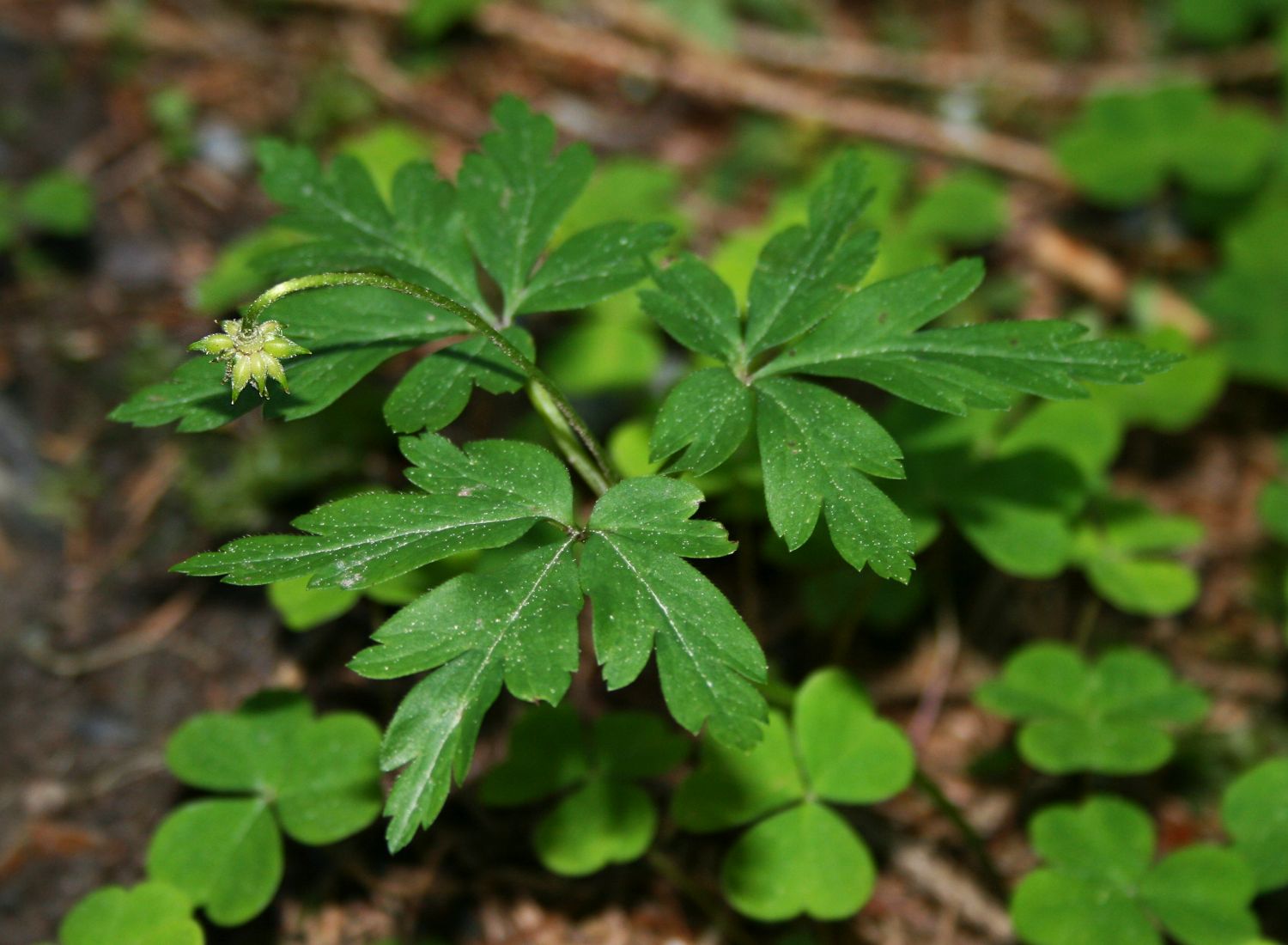
Planting density — the number of plants or propagules introduced per unit area — is one of the more consequential decisions in woodland ground cover establishment. Too sparse, and desirable species fail to suppress weedy colonisers or achieve the ecological functions of a continuous ground layer. Too dense, and establishment costs rise unnecessarily while early-stage competition between transplants can reduce survival.
For native understory plants in Polish oak woodland, appropriate density depends on three variables: the growth form and lateral spread rate of the species, the light regime at the planting site, and the condition of the existing ground layer and litter.
General Principles
Species with fast horizontal spread — stoloniferous or rhizomatous herbs such as Galium odoratum or Lamium galeobdolon — can be introduced at lower initial densities than clump-forming or slowly spreading species. The cost of this approach is time: areas planted at low density may take several growing seasons to achieve continuous cover. In sites where weed pressure or bare soil exposure is a concern, initial density should be increased.
Species that spread primarily by seed, such as Viola reichenbachiana, may be introduced either as transplants or via seed. Transplants give more predictable spatial distribution; seed introduction is less expensive per unit area but depends heavily on suitable germination conditions, which in shaded forest may be inconsistent between years.
Density Ranges by Species and Site Condition
The following table summarises density ranges applicable to planting in Polish lowland and upland oak woodland. Ranges reflect variation in site condition — lower values suit moist, sheltered sites with existing litter; higher values suit drier or more exposed conditions where early competition risk is greater.
| Species | Growth Form | Transplant Density (plants/m²) | Notes |
|---|---|---|---|
| Galium odoratum | Rhizomatous | 4–8 | Spreads to fill gaps within 2–4 seasons on moist sites |
| Asarum europaeum | Low rhizomatous | 6–12 | Very slow spread; higher density required for reasonable cover timeline |
| Lamium galeobdolon | Stoloniferous | 3–6 | Fast-spreading; monitor spread into adjacent non-target areas |
| Carex sylvatica | Tufted sedge | 4–8 | Does not form continuous mat; tufted structural cover |
| Viola reichenbachiana | Rosette, self-seeds | 6–10 (transplants) or seed | Self-seeds reliably once established; initial density can be modest |
| Anemone nemorosa | Rhizomatous ephemeral | 10–20 rhizome sections/m² | Planted as divided rhizomes in autumn; cover not visible until spring |
| Oxalis acetosella | Rhizomatous | 8–16 | Suited to acidic soils; establish from divisions in spring or autumn |
Timing of Planting
For most rhizomatous species, the two planting windows are early spring (March–April, before leaf-out) and autumn (September–October, after leaf-fall but before ground frost). Spring planting allows transplants to benefit from the peak light period before canopy closure. Autumn planting allows root establishment over winter with minimal water demand and reduces transplant shock in dry summers.
Anemone nemorosa rhizomes should be planted in autumn — they require a cold period for spring emergence and do not establish well from spring-planted material. Galium odoratum root divisions establish from either season, though spring planting on moist sites often produces faster initial spread.

Root Competition Effects on Density
In well-established oak stands, fine root density in the upper 20–30 cm of soil can be considerable. For transplants, this creates competition for soil moisture that is most acute during dry spells in the first summer after planting. Species with deeper or more extensive root systems — such as Polygonatum multiflorum — are less affected than shallow-rooted species.
Watering during the first summer is rarely practical across large areas of woodland planting, so species selection and timing are more effective risk-management tools than supplemental irrigation. Choosing species with established drought tolerance records in oak woodland — Viola reichenbachiana and Carex sylvatica among them — reduces first-year loss in dry years.
Canopy Dynamics and Long-Term Density
Planting density should be considered against the expected canopy trajectory. In stands where the canopy is not yet fully closed, temporary high light availability may favour faster-growing species that become problematic under deeper shade once the canopy matures. Conversely, in old-growth oak stands where light is consistently very low, only the most shade-tolerant species will persist regardless of initial density.
Establishing a diverse mixture of species — including both ephemerals and persistent shade-tolerant herbs — is generally more resilient across the range of canopy conditions found in a real woodland mosaic than planting a single species at high density.
Sourcing Material
For restoration planting in existing oak woodland, local provenance plant material is generally recommended. The General Directorate for Environmental Protection in Poland (GDOŚ) provides guidance on appropriate provenance for native plant introduction. Nursery-grown material of Polish origin is available through several specialist native plant nurseries; obtaining plants from outside the region introduces uncertainty about ecotypic adaptation.
Summary: Practical Density Guidance
- Fast-spreading species (stolons, rhizomes): 3–8 plants/m² is typically sufficient
- Slow-spreading species (Asarum europaeum): 8–12 plants/m² for reasonable cover within 5 years
- Ephemeral rhizomes (Anemone nemorosa): 10–20 sections/m², planted in autumn
- Self-seeding species (Viola spp.): modest transplant density (6–10/m²) reduces cost; self-seeding fills gaps over time
- Mixed plantings at moderate density (4–8/m² average) outperform monocultures in most woodland conditions
References
- Matuszkiewicz, J.M. (2001). Zespoły leśne Polski. Wydawnictwo Naukowe PWN, Warsaw.
- Falkowski, M. & Kukuła, K. (2000). Biologia roślin łąkowych i leśnych. Wydawnictwo Akademii Rolniczej, Kraków.
- General Directorate for Environmental Protection (GDOŚ), Poland
- Peterken, G.F. (1993). Woodland Conservation and Management. 2nd ed., Chapman & Hall.